
How to Rent an SUV for Your Bali Adventure
Planning to rent suv car in bali? Follow a practical self-drive itinerary, check licence requirements, compare rental quotes, and budget for your trip.

How to rent an SUV for a self-drive Bali trip
An SUV’s passenger capacity does not tell you whether it will hold everyone’s luggage: to rent one for a self-drive Bali trip, choose for people and bags together, then confirm that the vehicle is available without a driver. Before committing, establish your eligibility to drive, the total rental cost and which vehicle the provider will actually supply.
If you search “rent suv car in bali,” treat the results as a shortlist, not proof of suitability. Start your enquiry with Cars 4 Rent Bali by describing what you need rather than assuming a particular SUV or rental arrangement is available.
Start with the load, not the label
Consider a trip where you arrive with fellow travellers, suitcases and day bags, stay in Ubud, then leave the larger bags at your accommodation during outings. The airport transfer is your fullest load; choose around that, not the lighter days that follow.
“Self-drive” means you drive the rental vehicle yourself rather than hiring a vehicle with a driver. “SUV” describes a vehicle category, not a promise of luggage space, four-wheel drive or permission to use unpaved roads.
Use this order to narrow the choice:
- Describe the full travelling load. Include everyone travelling and all luggage, including bulky items that cannot fit on laps or obstruct visibility.
- Ask about usable space. Establish whether the suggested seating arrangement leaves enough room for those bags. A vehicle that works only with seats folded may not work for your group.
- State your driving preferences. Specify whether you need an automatic transmission rather than leaving it to assumption.
- Check practical fit. Consider whether you would feel comfortable manoeuvring and parking the proposed vehicle. Bigger is not automatically more useful.
Treat suitability and affordability as separate checks
For this trip, the right outcome is a vehicle that carries the full arrival load safely and remains manageable once you start exploring. A lower advertised rate does not solve a space problem, and a larger vehicle does not solve a confidence problem.
Keep the rental budget separate from general arrival expenses. For example, Bali’s tourist levy is IDR 150,000 per foreign visitor, separate from the visa-on-arrival charge; it is not an SUV rental fee (U.S. Department of State).
Your first decision is therefore a practical brief: enough usable space, a suitable transmission and a vehicle you are comfortable driving. That gives the rental provider something concrete to assess before you move into booking details.
Map your airport-to-Ubud trip before choosing a vehicle
Start with the journey, not the SUV. If you land at Ngurah Rai Airport with luggage and plan to drive straight to accommodation in Ubud, the useful question is not “How big a vehicle can I get?” It is “What vehicle fits the people, bags and access at both ends?”
Treat that arrival drive as a complete route: the collection point, the journey to Ubud, and the final approach to your accommodation. A map pin alone does not tell you whether you can pull up outside reception, turn around or leave the vehicle overnight.
Work through the plan before choosing a size:
- Confirm the actual destination. Ask your accommodation for its vehicle entrance and parking location, not just its address. Ask whether the final approach has any access restrictions or tight turns.
- Count luggage as well as passengers. Describe the bags you will carry and ask about usable luggage space with the required seats occupied. Seat capacity does not establish baggage capacity.
- Check the collection location. Establish where the airport handover would happen before building your route around it. Do not assume “airport collection” means a vehicle waiting at the terminal exit.
- Review the drive for your arrival window. Check navigation near departure rather than treating an advance journey estimate as fixed. Leave room between landing and any scheduled activity in Ubud.
- Plan the last stretch separately. Save the accommodation’s access instructions offline. If the entrance is unclear, identify somewhere suitable to stop and contact the property rather than improvising while driving.
Now weigh vehicle size against that route. More luggage space can help on arrival, but extra width is not automatically useful when the accommodation’s entrance or parking area is tight. Ask for dimensions and luggage-space details rather than relying on the SUV label.
Keep route costs distinct from the rental quote. If your chosen route uses the Bali Mandara toll road, its published class I tariff was Rp14,000 per trip, effective April 2024; check the current charge before travelling (published tariff). Do not add a toll simply because the trip starts at the airport—check the route first.
For a broader assessment of whether you want to drive after landing, review safety considerations for renting a car in Bali. Your finished plan should identify the collection point, destination entrance, parking arrangement and passenger-and-luggage needs: enough detail to choose a vehicle for the trip you will actually make.
Check your driving documents before requesting a booking
Suppose you plan to collect an SUV near Bali’s airport and drive to Ubud, with your partner sharing the driving. Before requesting a booking, check both drivers’ documents—not just the person whose name will appear on the enquiry.

A rental booking is not proof that you meet Indonesia’s driving requirements. Sort out your eligibility before committing money or relying on a self-drive airport departure.
Start with your licence and International Driving Permit
An International Driving Permit, or IDP, is a document used alongside your domestic driving licence; it is not a replacement for it. The U.S. Department of State states that a valid U.S. licence alone is not recognised for driving in Indonesia and that foreign drivers must carry an IDP (source).
Australian travellers receive similarly explicit guidance: they need an Indonesian licence or an IDP in addition to their Australian driving licence (source).
Work through this check before sending document copies:
- Check validity across the trip. Read the expiry dates on your domestic licence and IDP against your intended driving dates, including the return journey.
- Check the vehicle category. Confirm that your documents cover the type of vehicle you intend to drive. Do not assume permission to ride a motorcycle establishes permission to drive a car.
- Check each intended driver separately. If your partner might take over on the way to Ubud, complete the same checks for them before requesting the booking.
- Check how to obtain the IDP. Consult the authorised issuing organisation in your home country about the appropriate permit, application process and processing time before departure.
Separate document costs from rental costs
If you need an IDP, confirm its application fee and any delivery charge directly with the issuing organisation. Those are document-preparation costs, not the SUV’s rental price; leave time to complete the process rather than assuming you can resolve it at collection.
Prepare your passport, domestic licence and IDP, then ask the rental provider which documents it needs to review and which originals you must present. Ask how to submit copies securely rather than sending identity documents through an unverified contact.
The useful outcome is straightforward: every intended driver has checked their documents, identified any missing permit and knows what to present. If something is missing, resolve it before making the self-drive booking—not after landing with luggage and an onward journey waiting.
Send a clear enquiry and confirm the rental terms
Suppose you plan to collect an SUV at Bali airport, drive to Ubud and return it before your flight home. Your enquiry should let the rental provider confirm that exact booking—not simply reply that an SUV is “available.”
Send the details together, rather than spreading them across separate messages:
- Timing: arrival date, flight number, requested handover time and return date and time.
- Locations: airport collection, your Ubud accommodation address if relevant to delivery, and the proposed return point.
- Space: passenger count and luggage, including bulky items. Ask whether the offered vehicle can accommodate both.
- Driving preferences: self-drive, preferred transmission and whether anyone else will drive.
- Contact: a number the provider can reach on arrival and a request for the handover contact’s details.
A useful message looks like this:
I’d like to book a self-drive SUV for airport collection, with Ubud as our base. My arrival and return details, passenger count and luggage details are below. Please confirm the vehicle offered, transmission, availability and booking terms. Is the exact vehicle confirmed, or could you supply a substitute? Please also explain the airport meeting procedure and what happens if our flight is delayed.
Next, ask for the terms that determine whether the arrangement works. A vehicle being available is not the same as a booking being confirmed. Ask what secures the reservation, when payment becomes due and what written confirmation you will receive.
Keep these questions specific:
- Substitution: If the offered vehicle becomes unavailable, what replacement can the provider supply, and can you decline it?
- Permitted use: Does the agreement allow your intended driving area, and does it exclude particular roads or activities?
- Breakdowns and incidents: Who should you contact, what assistance is included, and what procedure must you follow?
- Changes and cancellation: What happens if your flight changes, you shorten the rental or you cancel?
For costs, establish the commitment rather than accepting an unexplained payment request. Ask whether the reservation payment is refundable, whether it counts towards the rental balance, and whether changing collection time triggers a charge. Have the provider put any applicable amount and deadline in writing; review the complete quote separately.
Finish by asking the provider to confirm the agreed details in a single message or booking document. The outcome you want is straightforward: a defined vehicle arrangement, clear handover instructions and written terms you understand before sending money.
Build the budget from the full written quote
For an airport pickup followed by a stay in Ubud, the daily SUV rate is only the starting point. Build your budget from the written total for your actual pickup and return times, then separate what you will spend from money you may need temporarily for a deposit.
A full written quote should make every included charge and possible extra visible. “Possible” matters: a late-return charge is not part of your planned spend, but you should know what triggers it and how the provider calculates it.
Work through the budget in this order:
- Start with the rental subtotal. Ask for the number of chargeable rental periods and the total for your exact dates and times. Do not calculate it from calendar dates alone; ask how the provider treats a partial rental period.
- Add collection and delivery costs. For your airport-to-Ubud trip, ask whether the quoted total includes airport handover and collection at your chosen return location. Have any applicable out-of-hours or different-location charges itemised.
- Identify optional charges. Ask which extras, if any, you have requested and whether each price covers the whole booking or each rental period. Keep anything you do not need out of the total.
- Separate cover from liability. If the quote includes or offers damage cover, record its cost separately from the excess—the amount you may still have to pay toward a covered claim. Ask about exclusions rather than treating “insurance included” as a complete answer.
- Set aside operating money. Keep fuel, parking and any toll use outside the rental subtotal unless the quote expressly includes them.
Treat the security deposit as a separate cash-flow requirement, not automatically as a rental expense. Ask how much money is held, how you must provide it, and what release conditions apply. Your available travel funds need to cover that hold as well as your expected spending.
Keep destination charges separate, too. Foreign tourists entering Bali must pay a IDR 150,000 levy per person, separate from the e-VOA or Visa on Arrival, according to the U.S. Department of State. That belongs in your trip budget, not your vehicle-rate comparison.
The useful outcome is a budget with distinct amounts: the quoted rental cost, expected spending on the road, the deposit requirement and potential liability. Compare providers on that basis. A cheaper daily rate tells you little until you know what the complete booking will cost.
Inspect the SUV, then follow your planned route
You have landed in Bali, your luggage is beside the SUV, and your accommodation in Ubud is saved on your phone. Before you leave the handover point, check the vehicle with the person releasing it. This is the moment to resolve a warning light, damaged tyre or missing item—not after you have joined traffic.
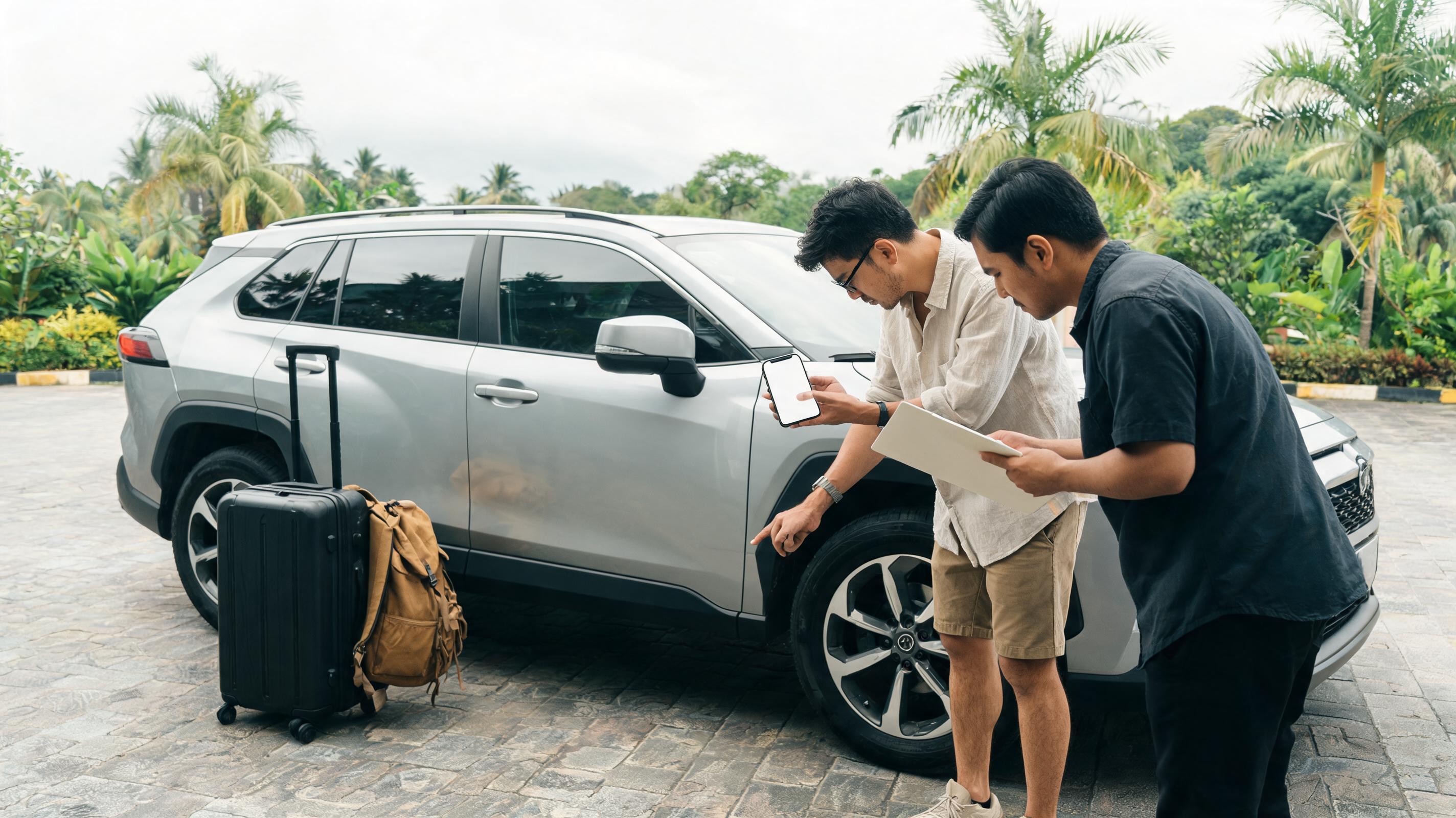
A handover inspection creates a shared record of the SUV’s condition before you drive it. Take clear photos and a continuous walk-around video, then ask the rental representative to record any existing damage on the handover document.
- Check the exterior: photograph each side, the bumpers, wheels, windscreen and mirrors. Look for scratches, dents, cracked glass and visible tyre damage; ask the representative to address anything that looks unsafe.
- Check the cabin: test the seat belts, adjust the driving position and mirrors, and make sure your luggage fits without blocking your view. Try the air-conditioning, lights, indicators, wipers and washers before moving.
- Record the dashboard: photograph the fuel gauge and odometer. Ask about any warning light that stays on after the engine starts.
- Locate the essentials: ask where the spare wheel or repair equipment is, how to open the fuel flap, which fuel to use and whom to contact if the SUV breaks down.
Buckle up before leaving, and have every passenger do the same. Indonesian law specifically requires the driver and front-seat passenger in a four-wheel vehicle to wear seat belts; the stated fine for a breach is Rp250,000 (source).
Set your navigation while parked, secure your phone in its holder and review the first turns. If the handover location allows it, check steering and braking at low speed before joining the road; stop and raise any concern rather than trying to diagnose it while driving.
For the airport-to-Ubud leg, follow the route you already assessed rather than accepting every suggested shortcut. If navigation sends you towards a lane whose width or surface looks unsuitable, stop somewhere safe and reassess. An SUV is not a reason to force a narrow passage.
Keep spending tied to the actual journey: fuel, parking and any tolls you use. If a charge or payment method is unclear, ask before proceeding rather than improvising at a barrier.
The immediate goal is straightforward: leave with a documented vehicle, working controls and navigation you can follow without handling your phone. If fatigue makes that difficult, pause somewhere safe instead of pushing through to Ubud.
Return the vehicle and close out the trip
Suppose your self-drive trip ends with a drive from Ubud to the airport. Treat the SUV return as a separate appointment before your flight, not something to squeeze in at the departures kerb. You need time to reach the agreed handover point, remove your luggage and finish the return check.
Before leaving Ubud, message the rental provider to reconfirm the exact location, handover time and contact person. Ask what to do if traffic delays you or the representative is not there; do not assume you can leave the keys with airport staff or a parking attendant.
Work through the return in this order:
- Meet the agreed fuel requirement. Follow the fuel policy in your rental agreement, keep the refuelling receipt and photograph the fuel gauge and odometer when you park.
- Clear the cabin and boot. Check door pockets, the glovebox, under seats and charging sockets. Remove your belongings and rubbish, and follow any cleaning obligations stated in the agreement.
- Record the vehicle’s condition. Take clear photos of the exterior, wheels, glass and interior at the return location. Keep the original files alongside your collection photos.
- Complete a joint walk-around. Ask the representative to identify any concerns before you leave. Compare any alleged new damage with the collection record rather than relying on memory.
- Get written handover confirmation. Request a record of the return time, fuel level, vehicle condition and any outstanding amount.
Your final payment should reconcile the rental agreement with what happened during the hire. If the provider requests a fuel, cleaning, late-return or damage charge, ask for the contractual basis and an itemised calculation before accepting it. A verbal total is not an itemised bill.
If you paid a refundable deposit, ask whether the provider has refunded a payment or released a card hold—these are different transactions. Request confirmation of the amount, any deductions and the expected processing timeframe; do not assume the money will appear immediately.
If nobody attends the handover, contact the provider and request written instructions before leaving the SUV. Document where and when you parked, but remember that photos alone do not establish an agreed unattended return.
The trip is closed out when you have written evidence that the provider received the vehicle, a final account and a clear record of the deposit status. Keep those records together until any outstanding payment or deposit issue is resolved.
FAQ
Can I hire an SUV in Bali and drive it myself?
Ask the rental provider to confirm self-drive SUV availability for your dates and whether you meet its driver requirements. Check licence eligibility, insurance terms, and any route restrictions before paying.
What licence do I need to rent a car in Bali?
Check Indonesian driving requirements for your nationality before travelling. For Australian drivers, Smartraveller says an Indonesian licence or an International Driving Permit is required in addition to an Australian driving licence.
How much does it cost to hire an SUV in Bali?
Request a written quote for your dates, vehicle category, and collection arrangements. Compare the total payable, including any confirmed extras, and check the refundable deposit and insurance excess separately.
Can I collect my rental SUV at Bali airport?
Ask whether airport collection is available and whether it carries an additional charge. Confirm the meeting point, flight-delay procedure, and return arrangements in writing.
Is an SUV a good choice for staying in Ubud?
It can suit your passenger and luggage needs, but size matters on narrow accommodation approaches and in small parking areas. Check access with your host and discuss your itinerary with the rental provider before choosing a vehicle.